Newsletter Subscribe
Enter your email address below and subscribe to our newsletter

 ByJohn A
Natural daylight can make a significant difference to a commercial building. In warehouses, workshops, retail premises, offices, and industrial units, well-positioned rooflights can bring daylight into areas that may otherwise depend heavily on artificial lighting.
For businesses planning a new installation or replacing an existing system, knowing what to look for is just as important as selecting the right style. Factors such as roof type, building use, glazing material, thermal performance, ventilation, and maintenance requirements can all affect the suitability of a rooflight.
This guide explains the main considerations for businesses planning to shop commercial rooflights, helping them understand the available options before making a purchase.
Commercial rooflights are roof-mounted glazing systems designed to introduce natural light into large buildings. They can be installed as individual units, continuous roof panels, roof windows, or larger skylight systems.
Unlike residential roof windows, commercial rooflights are generally designed for larger roof areas and demanding environments. A warehouse may require a different specification from an office or retail building.
The right product depends largely on the building’s purpose and the conditions under which the rooflight will operate.
See also: How 3-Phase Pad-Mounted Transformers Support Modern Power Distribution
Daylight can make large indoor spaces feel brighter and more comfortable. In workplaces, it can also reduce the need to rely on artificial lighting during daylight hours.
For warehouses and industrial buildings, roof-mounted glazing can distribute daylight across areas where wall windows may not provide sufficient coverage. This can be particularly useful in deep-plan buildings where natural light from the perimeter does not reach the centre of the space.
The amount of daylight entering a building depends on several factors, including rooflight size, glazing type, orientation, roof design, and surrounding structures.
There are several types of roof-mounted glazing available for commercial buildings. The best choice depends on the structure and the intended use of the space.
Commercial skylights are commonly used where businesses need dedicated glazed sections within a roof. They can work well in offices, retail spaces, communal areas, and other commercial environments where daylight is a priority.
Rooflight panels may be more suitable for large industrial buildings, while individual roof windows can provide focused areas of daylight. Some systems can also be combined with ventilation features where airflow is required.
Before selecting a design, businesses should check the roof construction, available space, loading requirements, and installation method.
Standard rooflight dimensions will not suit every commercial building. Older structures, unusual roof layouts, extensions, and buildings with specific architectural requirements may require a different configuration.
Custom commercial skylights can be manufactured around particular dimensions or design requirements. This may allow businesses to make better use of available roof space rather than adapting the building around a standard product.
Customisation can involve dimensions, glazing specifications, framing, opening mechanisms, and other technical features. The exact options depend on the manufacturer and the building requirements.
A detailed survey before ordering can help identify potential installation issues and ensure the chosen system is appropriate for the roof structure.
Some commercial buildings benefit from roof windows rather than larger skylight installations. These can provide direct daylight through a defined opening and may be useful in offices, workshops, converted commercial premises, and smaller workspaces.
Commercial roof windows are available in different configurations and materials. Fixed units are designed primarily for daylight, while opening systems can provide additional ventilation.
The choice between fixed and opening roof windows should be based on how the room is used. Areas requiring regular ventilation may benefit from operable units, while spaces with existing mechanical ventilation may have different requirements.
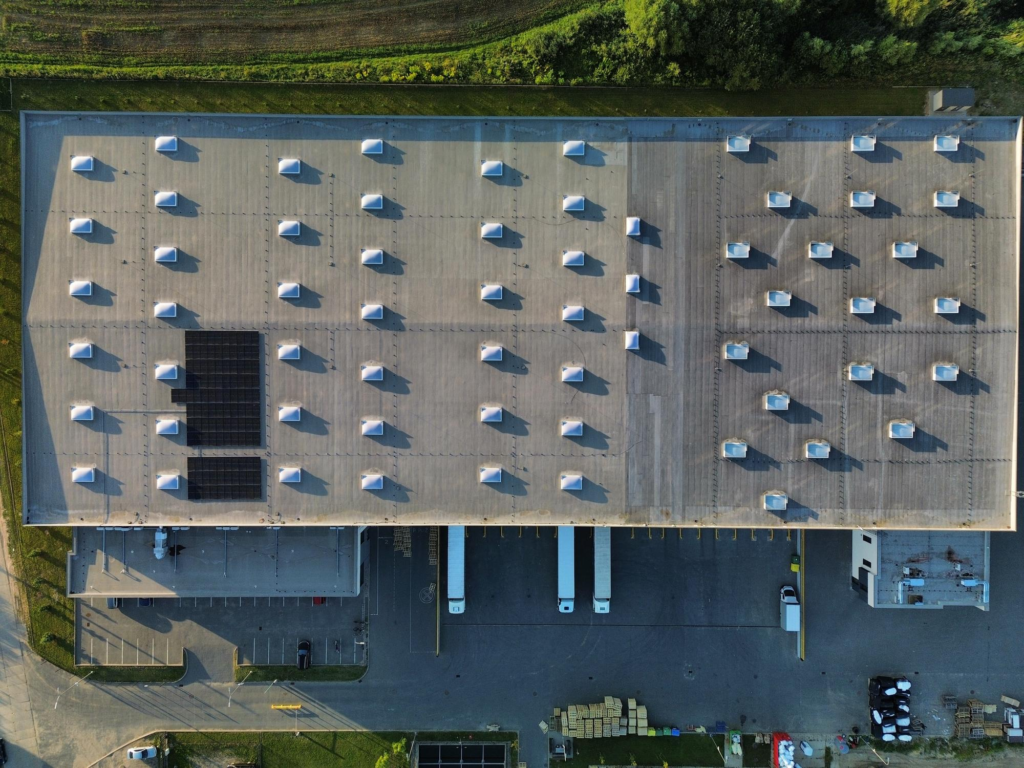
Large warehouses often have substantial roof areas with limited access to natural light. Roof-mounted glazing can help distribute daylight throughout the building, particularly when wall openings are restricted by storage systems, machinery, or the building’s layout.
Warehouse roof lights are often designed with durability and light transmission in mind. Their specification should take account of the roof construction, internal environment, expected foot traffic during maintenance, and exposure to weather.
For large facilities, the positioning and proportion of rooflights matter. Too little glazing may provide insufficient daylight, while poorly planned installations can create unwanted heat gain or glare.
Businesses should therefore consider the entire roof layout rather than treating each rooflight as an isolated feature.
The material used for a rooflight affects its appearance, durability, insulation characteristics, and light transmission.
Common options include polycarbonate, acrylic, glass, and other specialist glazing materials. Each has different characteristics.
Polycarbonate can offer impact resistance and is often used in demanding commercial environments. Glass may be selected where appearance, clarity, or particular thermal specifications are priorities.
Glazing can also vary in transparency and light diffusion. Diffused materials can spread daylight more evenly and may reduce harsh contrasts inside a building.
When businesses shop commercial rooflights, they should compare the technical specifications rather than selecting a product based solely on appearance or price.
Roof glazing can influence the internal temperature of a building. During colder periods, the rooflight specification can affect heat retention, while solar gain can become a consideration during warmer weather.
The appropriate balance depends on the building, climate, roof design, and heating or cooling systems already in place.
Businesses should examine the manufacturer’s thermal performance data and check whether the proposed installation meets applicable building requirements. Professional advice may be appropriate for larger projects where rooflight performance forms part of the wider building design.
Installation should be considered alongside the product itself. The existing roof structure, waterproofing details, drainage, access arrangements, and maintenance requirements all need attention.
A poorly planned installation can create problems even when the rooflight itself is suitable. Roof penetrations must be properly detailed and sealed, while surrounding materials should be compatible with the chosen system.
For larger commercial projects, working with an experienced installer can help identify structural and practical issues before work begins.
A useful comparison should cover more than dimensions and price. Businesses can create a simple checklist covering:
It is also worth considering the building’s future use. A rooflight that suits the current layout may need to remain practical if the space is later reorganised.
Large offices, factories, retail premises, and industrial facilities may require several types of daylighting systems across different sections of the building.
Commercial building skylights can be incorporated into broader daylighting plans, allowing designers to consider how natural light moves through the interior rather than simply adding isolated roof openings.
The final arrangement should account for the building’s orientation, roof geometry, internal partitions, equipment, and areas where daylight is most useful.
For major developments, daylight modelling and professional design input can help determine suitable rooflight areas and positions.
Selecting a commercial rooflight is ultimately a balance between daylight requirements, roof construction, building use, performance specifications, and installation constraints.
Businesses preparing to shop commercial rooflights can narrow their options by first identifying the purpose of the installation and the conditions in which the rooflight will operate. Comparing technical specifications and obtaining suitable installation advice can then make the purchasing process more straightforward.
A well-planned rooflight system should fit the building rather than simply occupying available roof space. Careful product selection at the planning stage can also reduce the likelihood of costly alterations later.